A Smarter Alternative to Group Health Insurance
Take control of your healthcare costs while giving your employees better plan options, without the limitations of traditional group coverage.

The Difference:
Predictable monthly budgets
No participation requirements
Employees choose their own plans
Why Traditional Group Health Plans Are Failing Small Employers
If you're like most small business owners, you've likely experienced the frustration of rising premiums, limited flexibility, and unpredictable renewals.
Traditional group health insurance puts the burden on the employer, leaving you with fewer options and increasing costs year after year.
Rising premiums with no control
Limited carrier and plan options
Participation and contribution requirements
Financial risk placed on the employer
There’s a better way to offer benefits without sacrificing control.
WHAT IS AN ICHRA?

An Individual Coverage Health Reimbursement Arrangement (ICHRA) allows employers to provide a fixed, tax-free reimbursement for employees to purchase their own individual health insurance.
Instead of offering a one-size-fits-all group plan, you define your budget and your employees choose the coverage that fits their needs.
3-Step Breakdown

Set Your Budget
You decide how much to contribute for each employee class.

Employees Choose Their Plan
You decide how much to contribute for each employee class.

Reimburse Tax-Free
You reimburse employees for premiums and eligible expenses—tax-free.
Why Employers Are Switching to ICHRA
ICHRA gives employers flexibility, control, and cost predictability, while giving employees more choice and personalization.
COMPARISON
Traditional Group Plan
ICHRA
Limited plan choices
Annual rate increases
Employer carries risk
Participation requirements
Employee-driven plan selection
Fixed employer contributions
Predictable costs
Flexible eligibility structures
ICHRA puts you back in control of your healthcare strategy.
Is ICHRA Right for Your Business?
ICHRA is a strong fit for many employers, especially those looking for flexibility and cost control.
Experiencing premium increases
Not currently offering benefits
Multi-location or diverse workforce
Want more control over healthcare spending
A Simple, Guided Process
We make transitioning to an ICHRA simple, compliant, and fully supported from start to finish.
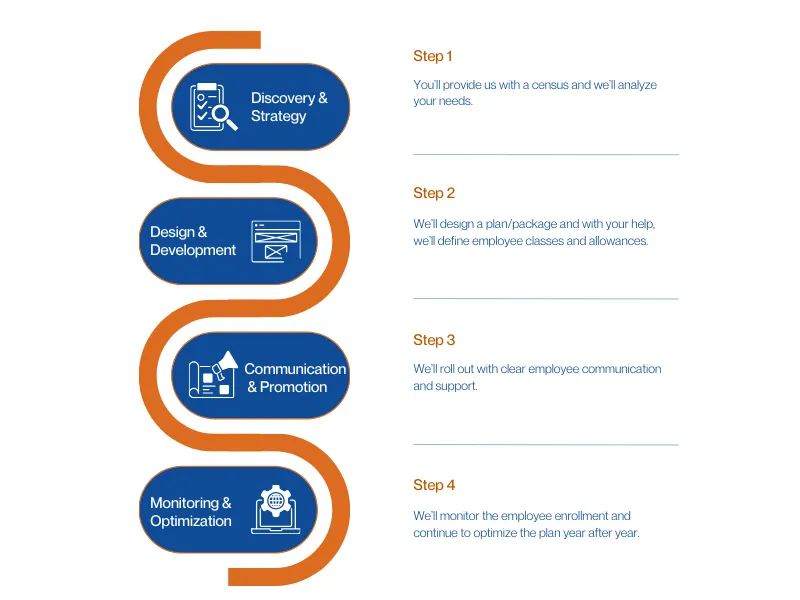
Licensed health insurance advisors
Compliance-focused approach
Ongoing year-round support
See the Potential Savings
Many employers are able to reduce healthcare costs while improving employee satisfaction.
Current Group Plan: $72,000/year
ICHRA Strategy: $54,000/year
👉 Estimated Savings: $18,000 annually

What Employers Are Saying

"The process was simple, and our team appreciated having the ability to choose their own coverage."
"We were facing a 22% renewal increase. Switching to ICHRA allowed us to control costs and give our employees better options."
"We finally feel in control of our healthcare spending."
Common Questions About ICHRA
Is ICHRA compliant with IRS and ACA regulations?
Yes. ICHRA is a fully compliant, federally recognized solution when structured correctly.
What if employees don’t enroll in coverage?
Employees must have individual health coverage to participate. We guide them through the process to ensure compliance.
Can I control how much I reimburse?
Absolutely. You set defined contribution amounts based on employee classes.
Is this better than a group plan?
For many small employers, ICHRA provides more flexibility, cost control, and employee satisfaction.
What industries work best with ICHRA?
ICHRA works well across many industries, especially those with diverse or distributed workforces.

Innovation
Fresh, creative solutions.

Integrity
Honesty and transparency.

Excellence
Top-notch services.
FOLLOW US


Copyright 2026. Forefront Broker Solutions. All Rights Reserved.
This website is for informational purposes only and does not constitute legal or tax advice. Always consult with a licensed advisor.